
Fall detection devices for elderly people in India: how to choose
Smartwatches, SOS pendants, cameras and radar sensors compared: how each one detects a fall, where it falls short, and the questions to ask before you buy one for your parents.
By Sparsh V Rao · · 9 min read
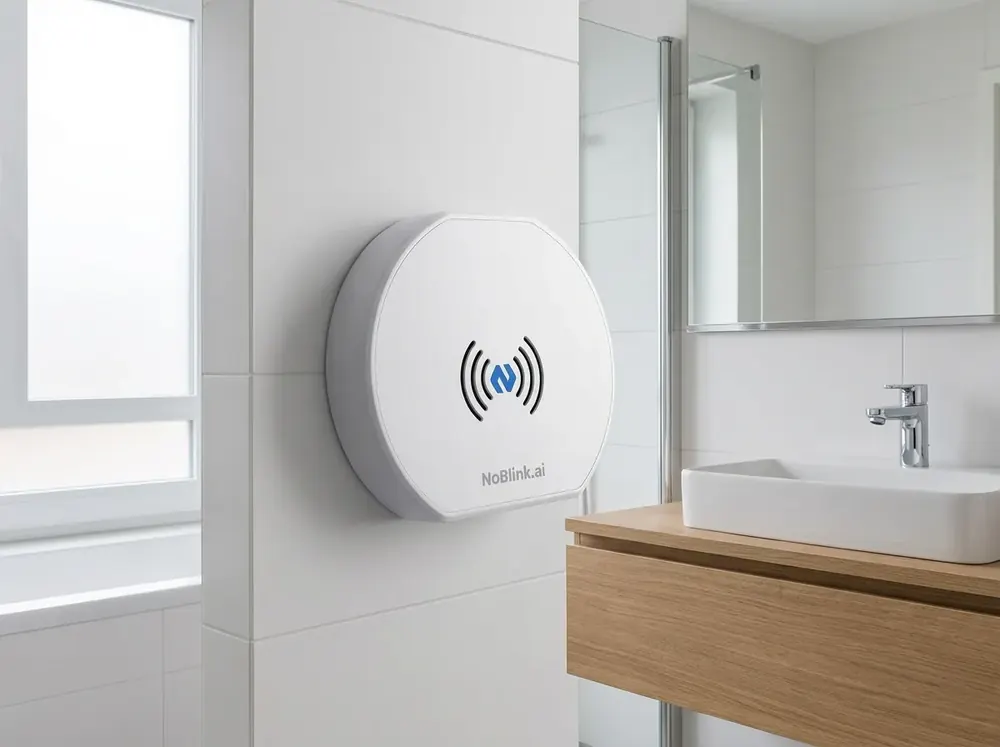
Search for a fall detection device for an elderly parent in India and you will find smartwatches, SOS pendants, GPS trackers, home cameras and, more recently, radar sensors that sit on the wall. They all promise the same thing, but they work in very different ways, and each has blind spots. This guide explains how each type detects a fall, where it falls short, and what to ask before you spend money.
A note on where we stand: NoBlink makes wall-mounted radar sensors. We have tried to be fair to every option here, including the ones we do not sell, because the right answer depends on your parents.
Every system has two halves
It helps to judge any device on two separate questions:
- Detection. Does it notice the fall by itself, or does it rely on the person pressing a button? Does it work in the rooms where falls actually happen?
- Response. Once it knows, who does it tell, how quickly, and what happens if that person does not answer?
A device that detects brilliantly but alerts nobody useful is no better than one that never noticed.
Smartwatches with fall detection
Several smartwatches can detect a hard fall. Apple Watch is the best-documented example: fall detection switches on automatically for people aged 55 and over. After a hard fall, if the wearer stays still for about a minute, the watch starts a countdown, then calls emergency services and messages emergency contacts with their location.
Good for: active parents who go out on their own. The watch protects them on a walk or in the market, not just at home.
Watch out for: it has to be worn and charged, and most people take it off to bathe and charge it overnight. Apple also says plainly that the watch cannot detect all falls, and that it needs a cellular, Wi-Fi or satellite connection to call for help. Many older people find the screen and settings fiddly.
SOS pendants, buttons and GPS trackers
These are worn around the neck or wrist, or carried. Most have a large button to call for help. Some add automatic fall detection or GPS location, often with a SIM card and a monthly plan.
Good for: parents who will reliably wear one and are confident pressing a button.
Watch out for: the same wearing and charging problem, and the button itself. In a UK study of people over 90, those who fell alone and could not get up did not use their call alarm in 80% of those falls. Some had taken it off, some did not want to bother anyone, and some could not reach or press it.
Home cameras
A home camera lets family look in on a parent, and some newer models try to spot falls with software.
Good for: checking on a living room or entrance, if your parents are comfortable with it.
Watch out for: privacy. Most people will not accept a camera in the bathroom or bedroom, which is exactly where many falls happen. Cameras also struggle in the dark, and a basic camera only helps if someone is watching at the right moment. Some parents feel watched and ask for it to be switched off.
Ambient radar sensors
These are small units mounted on the wall. They send out low-power radio waves and read the reflections to track movement and position, without forming an image. When they detect a fall, or a person lying still for too long, the system raises the alert by itself. NoBlink works this way.
Good for: parents who mostly stay at home, refuse to wear anything, or forget to charge things. They work in the bathroom, through steam and in the dark, and need nothing from the person.
Watch out for: they only cover the rooms where a sensor is installed, so they do nothing on a walk outside. They need power and a Wi-Fi connection at home. As with every type of device, no sensor catches every fall.
Other options you may come across
- Motion sensors. Basic motion detectors can show whether someone is moving around the house, which helps spot an unusual quiet day. On their own they cannot tell a fall from someone sitting still.
- Pressure mats. Mats beside the bed can show when someone gets up. They only cover the patch of floor they sit on.
- Smart speakers. Voice assistants can call a contact on command, which only helps if the person is conscious and able to speak.
Side by side
| Smartwatch | SOS pendant | Camera | Radar sensor | |
|---|---|---|---|---|
| Needs to be worn | Yes | Yes | No | No |
| Needs a button press | Not for falls it detects | Often | No, if it has detection software | No |
| Works in the bathroom | Only if kept on | Only if kept on | Not acceptable for most | Yes |
| Works in the dark | Yes | Yes | Often poorly | Yes |
| Works outside the home | Yes | Some models | No | No |
| Daily charging | Usually | Varies | No | No |
| Captures images | No | No | Yes | No |
Features vary between brands and models, so check the specific device before you buy.
Questions to ask before you buy
- Will my parent really wear it every day, including at night and in the bathroom?
- Does it detect falls by itself, or does it need a button press?
- Who gets alerted, and how: a call, an SMS, an app notification? What happens if the first person does not answer?
- What does it need to keep working: daily charging, a SIM card and plan, Wi-Fi, a power point?
- Is there a camera anywhere, and where is the data stored?
- Who installs it, and is there support in my parents’ city?
- What does it cost up front, and every month after that?
What we suggest to most families
- Parents who mostly stay home, or will not wear devices: ambient sensors in the bathroom and bedroom first, then the living areas.
- Active parents who go out alone: a smartwatch for outside, and a sensor in the bathroom for the hours the watch is off.
- Whatever you choose: build a small circle of people nearby who can reach the home quickly, and make sure they are the ones who get the first call.
If you want to understand how a sensor-based system works in practice, read how NoBlink fall detection works or our comparison of sensors and wearables.
Sources
- Apple Support, Use Fall Detection with Apple Watch
- Fleming J, Brayne C. Inability to get up after falling, subsequent time on floor, and summoning help: prospective cohort study in people over 90. BMJ 2008;337:a2227
- Stevens JA, Haas EN, Haileyesus T. Nonfatal bathroom injuries among persons aged 15 and over, United States, 2008. MMWR 2011;60(22):729-735
- World Health Organization, Falls fact sheet (2021)
Sparsh works on NoBlink and spends much of his time with older adults and their families, learning how falls actually happen at home and what helps people get help sooner.