
What to do if an elderly parent falls: a calm, step-by-step guide
What to do in the first few minutes after an older person falls, how to help them up safely, when to call 112, and what to do afterwards so the next fall is less likely.
By Sparsh V Rao · · 7 min read
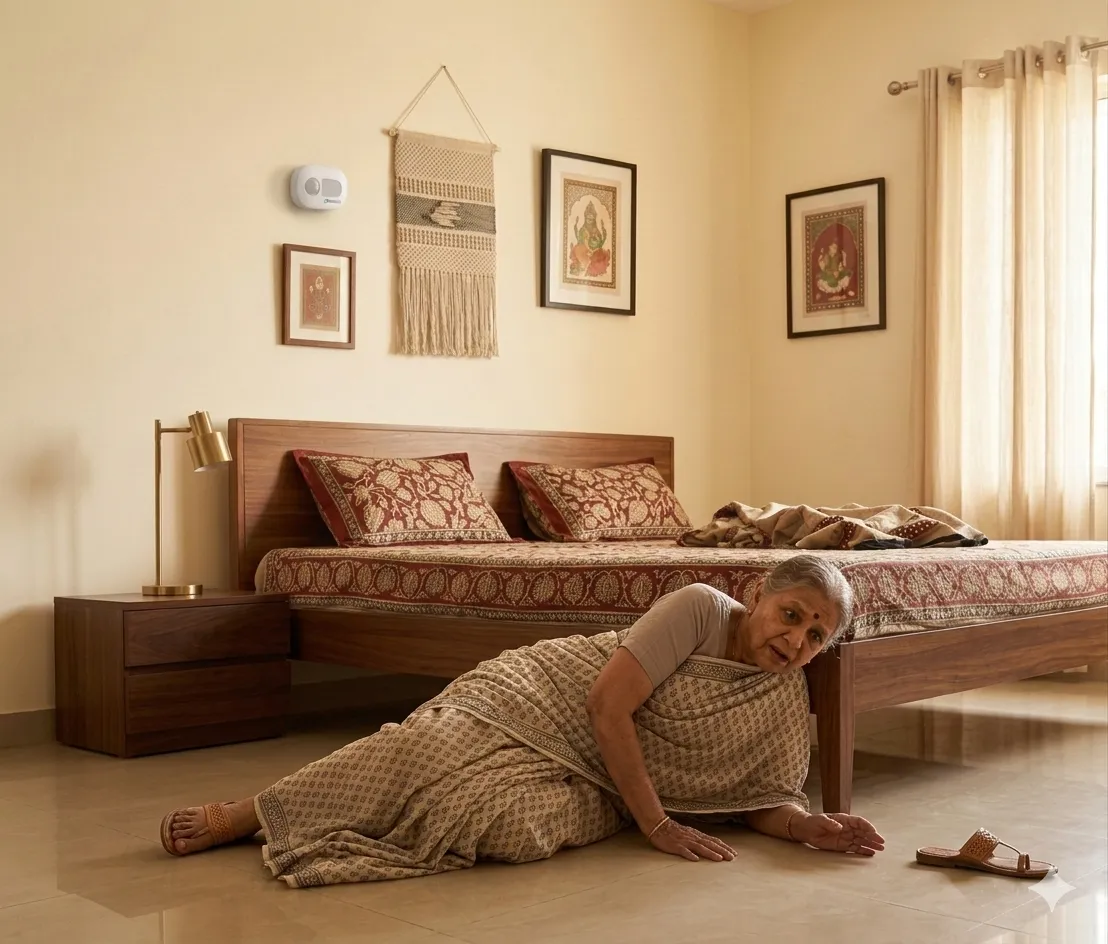
When an older parent falls, the instinct is to rush in and pull them up. Please do not. The first few minutes are about staying calm, checking for injury and deciding whether they can get up safely, or whether they need help to come to them. This guide follows the NHS advice on falls, adapted for families in India.
1. Stop, breathe and talk to them
Get down to their level and speak calmly. Ask what happened and whether anything hurts. A person who has just fallen is often shaken and embarrassed, and a calm voice helps them think clearly. Do not try to lift them while you work out what is going on.
Look for:
- Pain in the head, neck, back or hip
- Bleeding, or a limb lying at an odd angle
- Confusion, slurred speech or drowsiness
- Difficulty breathing, or not responding properly
2. Know when to call 112
Call 112, India’s national emergency number, or 108 for an ambulance, if they are unconscious, are struggling to breathe, may have hurt their head, neck, back or hip, or cannot get up. The NHS gives the same guidance: an injury to any of those areas, or being unable to get up, means calling for emergency help.
If they have hit their head and take a blood thinner, get medical advice even if they seem fine. Signs that need urgent care after a head injury include losing consciousness, a seizure, new weakness or numbness, trouble speaking or understanding, and problems with vision.
3. If they are not hurt and want to get up
The NHS describes a safe way to get up from the floor. Guide them through it, rather than lifting:
- Take your time. Do not get up too quickly.
- Roll onto your side, then use your arms to push up onto your hands and knees.
- Look for something stable to hold, such as a heavy piece of furniture, the side of the bed or a sturdy chair.
- Put one foot flat on the floor, then stand up slowly while holding on.
- Sit down and rest for a while before doing anything else.
Carefully help them if they can manage most of it themselves, but do not try to lift an adult off the floor on your own. You can hurt your own back, and if they have a fracture you can make it worse.
4. If they cannot get up
- Call for help, and stay with them if you are there.
- Keep them warm. Cover them with a blanket, a shawl or whatever is within reach. Floors get cold quickly.
- Make them as comfortable as you can, with a cushion under the head if their neck is not hurt.
- If the wait is long, help them change position gently about every 30 minutes, which the NHS recommends to help prevent pressure sores.
5. If you are far away when you hear
For many families the call comes from a neighbour, or not at all. If you live in another city or abroad, decide now what you will do in that moment:
- Call the nearest person on your list first. A neighbour five minutes away will reach your parent long before you can.
- Call 112 with the full address, a landmark, the flat number and the floor, and explain how to get in.
- Know where the spare key is, and who holds it.
- Keep a list of your parent’s medicines, allergies and doctor’s number on your phone to share with whoever arrives.
Why the time on the floor matters
Many older people simply cannot get up after a fall. In a well-known UK study of people over 90, 80% of those who fell were unable to get up on their own after at least one fall, and 30% lay on the floor for an hour or more. Those long lies were strongly linked to serious injury, admission to hospital and moving into long-term care. Among the falls where the person was alone and could not get up, 80% ended without the call alarm being used.
That is the real reason families look at fall detection. The aim is not to prevent the fall itself, but to make sure someone knows within minutes rather than hours. A system like NoBlink does that without asking your parent to wear or press anything.
After the fall, even if they seem fine
- Tell their doctor. A fall can be a sign of something else, such as a medicine side effect, an infection or a change in blood pressure. In the US, the CDC reports that fewer than half of older adults who fall tell their doctor.
- Watch them more closely for the next day or two, especially if they hit their head.
- Ask gently how they are feeling about it. Many people become afraid of falling again and start moving less, which weakens them further.
- Look at what caused it, and fix it. Our room-by-room fall prevention checklist is a good place to start.
Keep this somewhere handy
| If they are… | Do this |
|---|---|
| Unconscious, struggling to breathe, or hurt in the head, neck, back or hip | Call 112 or 108. Keep them warm and still. Do not move them. |
| Unable to get up but not badly hurt | Call for help. Keep them warm and comfortable. Change position every 30 minutes if the wait is long. |
| Unhurt and able to get up | Guide them: side, hands and knees, hold something stable, one foot flat, stand slowly, sit and rest. |
| Up again and seeming fine | Tell their doctor, watch them for a day or two, and fix what caused the fall. |
Sources
- NHS, Falls: what to do if you or someone else falls
- NHS, Head injury and concussion
- Fleming J, Brayne C. Inability to get up after falling, subsequent time on floor, and summoning help: prospective cohort study in people over 90. BMJ 2008;337:a2227
- Government of India, Emergency Response Support System (112)
- US Centers for Disease Control and Prevention, Older Adult Falls: Facts and Stats
Sparsh works on NoBlink and spends much of his time with older adults and their families, learning how falls actually happen at home and what helps people get help sooner.